Fellow citizens,
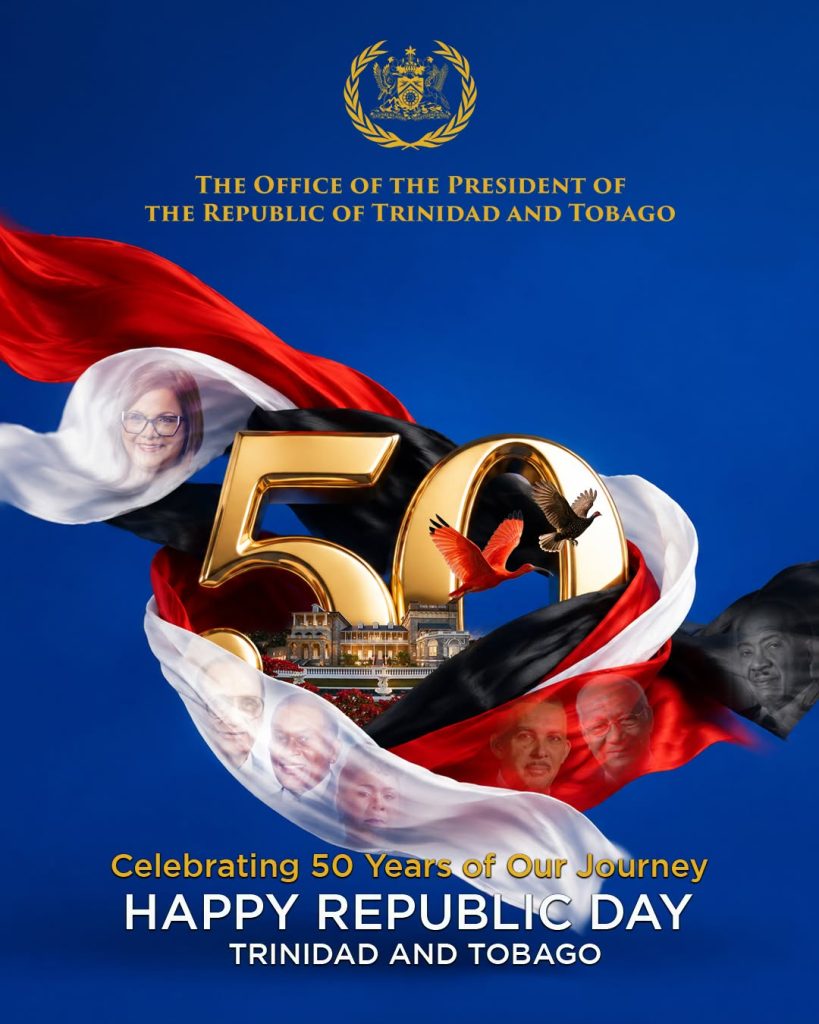
Fifty years ago, Trinidad and Tobago took another decisive step in its journey of self-determination. In becoming a Republic, we affirmed our confidence in our ability to order our own affairs, shape our own institutions and assume full responsibility for our common future.
The change was constitutional, but its deepest meaning was civic. Our allegiance was no longer owed to a distant monarch. It was owed to the Republic we had created and, ultimately, to one another. Sovereignty had become stewardship.
This fiftieth anniversary therefore invites more than celebration. It asks us to consider not only whether we have preserved the institutions of the Republic, but also whether we have upheld its character: whether public power is exercised with restraint; whether disagreement is conducted with dignity; whether every citizen enjoys an equal place; and whether liberty and security are protected together.
We should begin by recovering confidence in our own national identity. Our decision to become a Republic was an act of self-belief. It declared that, while we would remain open to the world, we did not need to become an imitation of anyone else. We can learn from other nations without borrowing their anger, their divisions or their habits of contempt. We can engage the world confidently while remaining unmistakably Trinidad and Tobago.
The language of our public life matters. A Republic is diminished when disagreement gives way to derision, when labels take the place of argument, or when provocation is mistaken for strength. Courtesy is not weakness, and restraint is not timidity. They are disciplines of democratic leadership, especially in a society as varied and closely woven as ours.
Our republican Constitution recognises and protects fundamental rights and freedoms. Those guarantees are not ornaments for tranquil times. They matter most when fear is greatest and the pressure to set them aside is strongest.
Crime has caused profound grief and anxiety in homes and communities across our country. The State has an undeniable duty to protect life, maintain public order and ensure that citizens can live without fear. Yet a mature Republic must protect security, liberty and the sanctity of life together. Measures adopted in the public interest must remain necessary, proportionate, accountable and subject to the law. Exceptional powers must remain truly exceptional.
We must be careful that fear does not persuade us, gradually and almost imperceptibly, that freedom is an obstacle to safety. Rights surrendered in anxious times are not always easily recovered. The strength of a constitutional democracy is measured not by whether it can exercise power, but by whether it can exercise power effectively without losing sight of the dignity and freedom of the people it exists to serve.
The same principle of dignity must govern how we regard one another. Trinidad and Tobago was shaped by its First Peoples and by successive journeys of forced passage, indenture, migration, refuge and choice. From those different histories, cultures and faiths, we have fashioned something rare: a national identity spacious enough to contain us all.
That inheritance places a duty upon us. No citizen should be reduced to a label; and no group should be made to feel that its place in the Republic is conditional. Equal citizenship means that the Republic belongs wholly and equally to every one of us – not by permission, not according to ancestry, and not only when it is politically convenient.
Our diversity will not preserve itself. It must be protected in the words we choose, the institutions we maintain and the judgments we make about one another. We honour our national character when we speak firmly without cruelty, enforce the law without contempt, disagree without dehumanising, and refuse to turn difference into suspicion.
Republican government also requires an active citizenry. Our duty is not exhausted by voting, nor by supporting those with whom we agree. It includes scrutinising power, defending the rights of others as carefully as our own, rejecting language that coarsens our common life, and insisting that public institutions serve the whole nation. The health of the Republic depends as much upon the standards citizens demand as upon the standards leaders observe.
After fifty years, the question is no longer whether we are capable of governing ourselves. It is whether we will govern ourselves well: with courage, but without harshness; with vigilance, but without fear; with pride in who we are, but without hostility towards those who are different.
The Republic is not merely the constitutional settlement we inherited in 1976. It is the daily choice to live as one people under law; to preserve both order and freedom; and to keep an equal place for every citizen within the national embrace. If we make that choice deliberately and consistently, we will not simply commemorate the promise of the Republic. We will renew it.
I wish every citizen of Trinidad and Tobago a peaceful and reflective Republic Day. May God bless our nation.