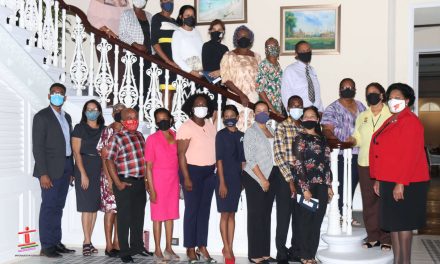
Twenty-six young people concluded six days of music, mentorship and personal development on Saturday July 18, 2026 as The President’s Pan Camp 2026 came to a triumphant close at The President’s House.
Now in its third consecutive year, the Camp brought together participants from the Cotton Tree Foundation, the Scout Association of Trinidad and Tobago, the Girl Guides Association of Trinidad and Tobago, the Trinidad and Tobago Cadet Force and Police Youth Clubs in Trinidad and Tobago for an immersive programme that extended well beyond learning to play the steelpan. Designed around the spirit of the panyard, the Camp created an environment where young people could learn, collaborate and grow. Alongside daily musical instruction, campers participated in sessions designed to build confidence, resilience, teamwork and leadership through the guidance of accomplished pannists, artistes and other professionals who shared both their expertise and their personal journeys.
The Camp culminated on Saturday with a closing ceremony attended by parents, guardians, representatives of the participating organisations and specially invited guests. Two campers reflected on their experiences through poetry and personal testimony before the 26 young musicians delighted the audience with a spirited performance of Farmer Nappy’s “How Ah Livin’”, the piece they had spent the week mastering, earning warm applause and a rousing reception from those in attendance.
Congratulating the campers on their impressive performance, Dr the Honourable Michael Dowlath, MP, Minister of Education, highlighted the importance of arts and culture in education and youth development.
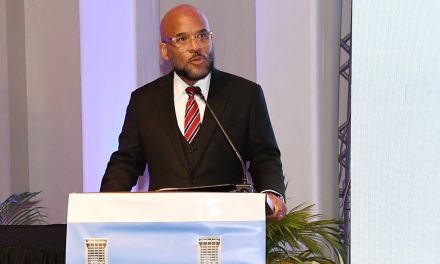
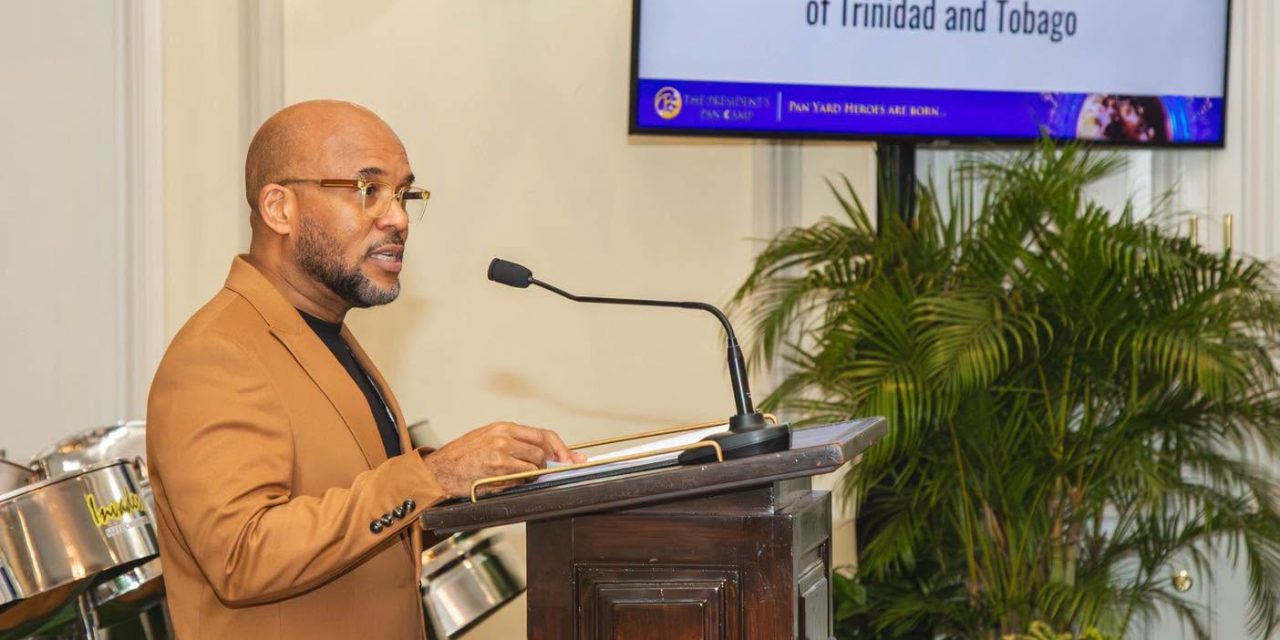
His Excellency Kerwyn Garcia S.C., First Gentleman of the Republic of Trinidad and Tobago delivered the feature address, reflecting on the broader significance of the President’s Pan Camp, describing it as an example of how music, mentorship and community can help shape confident young people and strengthen the future of the nation. He concluded that “when young people find their voices, a nation finds its future.”
See the full text of the address delivered by His Excellency Kerwyn Garcia S.C., First Gentleman of the Republic of Trinidad and Tobago below:
This afternoon, we heard the story of this Pan Camp told in several voices.
One Camper gave us poetry: pan as a place of freedom, peace and inspiration. A second Camper, through recorded testimony, gave us something more intimate: an account of struggle, perseverance and personal change. Mrs Michelle Huggins-Watts then showed us how carefully this experience was constructed—how music, mentorship, and care, created the conditions in which that change could occur. And the Honourable Minister reminded us that arts and culture are not extras in education, but essential parts of it—and that the steel orchestra teaches citizenship as surely as it teaches music. We thank him for that important affirmation.
The story of this Pan Camp having already been so poignantly told, I will not attempt to give you yet another account of the week just gone by. I wish, instead, to ask a more important question: what, then, does all of this mean?
At the opening ceremony on Monday, Her Excellency began with the words: “A steelpan does not find its voice by accident.” After what we have heard and witnessed today, we can add a companion truth: neither does a young person; and neither does a nation.
A pan finds its voice because skilled hands strike, listen, correct and tune. Over the last six days, twenty-six young people have also found new confidence, new competence and, in many cases, new voices because a community of skilled and generous adults chose to teach, to listen, to correct, to encourage and to care. As a result of that generosity, the most remarkable achievement of this Camp is not merely that twenty-six young people learned to play a piece of music in six days. It is that, in six days, we saw them change.
This is the third year in which we have witnessed that miracle. And, by every measure that matters, this third Camp has been an outstanding success. It succeeded not only because the Campers played the notes, but because they practiced the values behind the notes. They met and they interacted with facilitators, feature pannists, artistes and other presenters who all spoke with candour about their lives. These generous citizens did not offer polished fairy tales. They spoke honestly about struggle, rejection, disappointment, sacrifice, self-doubt and the long periods when no audience applauded. Different lives, all revealing the same grammar: work, discipline, perseverance and will.
Campers, remember that lesson. Talent can open a door; but only discipline can keep you in the room. A dream may show you a destination; but only hard work can actually take you places.
The steelpan itself bears witness to that truth. It does not emerge from metal through wishful thought. Heat, pressure, repeated blows, exacting skill and an attentive ear help it find its pitch. Pressure without care, can deform. Pressure guided by knowledge, patience and purpose however, can create a voice.
That distinction matters not only to music. It matters to the life of a nation.
But, before I turn to that wider lesson, I must discharge a duty which Her Excellency and I regard as one of the most important duties of this afternoon: the duty of gratitude.
To the men and women who planned, coordinated, taught, briefed, mentored, administered, solved problems and carried this Camp from an idea into reality, Her Excellency and I offer thanks deeper than ceremonial words can ever hold.
We thank Mr Ainsworth Mohammed; Mr Michael Dinchong; Mr Junia Regrello; Mr Colin Greaves; Mr Clarence Morris; Mrs Michelle Huggins-Watts; Mr Amrit Samaroo; Mrs Elizabeth Namsoo-Dinchong; Mr Emmanuel Joseph; Mr Shaquille Vincent; and Dr Mia Gormandy-Benjamin. In previous years, Her Excellency and I have called you friends. That word has not become less true with use; it has only grown the more so.
To the feature pannists, artistes and presenters: we thank you for giving the Campers access to the private roads behind public achievement. You showed them the setbacks behind the strength, the practice behind the polish, and the perseverance behind the applause. You shared not only what you know, but something of who you are.
We also thank the youth orchestras and bands which shared in the programme; our partner organisations; the parents and guardians who entrusted these young people to us; and the staff of the Office of the President, whose labour, care and attention sustained every day of the Camp.
We offer a special expression of gratitude to the Tobago House of Assembly, and to the Chief Secretary, the Honourable Farley Augustine, for enabling members of the Katzenjammers Youth Orchestra to travel from Tobago and share in one of the Camp’s afternoon sessions. The manner in which the Assembly responded to the Office of the President’s request was as meaningful as the assistance itself. Its response carried generosity, warmth and an institutional courtesy which stand as a model of how high public offices should communicate and cooperate in the service of young people and national culture. Although conflicting commitments prevent the Chief Secretary from joining us this afternoon, Her Excellency and I remain deeply grateful for his personal interest and for the Assembly’s steadfast support. Your gracious partnership ensured that distance did not deny these young musicians a place in this national experience. We shall remember both the assistance, and the grace with which it was given, with profound appreciation.
Her Excellency and I are deeply and profoundly moved by the spirit in which all of you have served. Every one of you gave your time, your knowledge and your heart – and all of this, at no cost whatsoever to the Camp. We do not say that as though your contribution cost nothing. Your time had value. Your preparation had value. Your experience had value. Your presence took you away from work, family, rest and private obligations. Yet you gave all of that without a fee. But yours is not labour without value. It is labour freely given, despite its value. It is one of the purest forms of patriotism. Patriotism does not live only in an anthem, a flag or a formal pledge. It also lives in the hour a citizen gives to a young person—in attention, patience, example and care for the next generation. Our country often asks where hope can be found. This week, hope arrived in you.
And now, I return to the wider, national lessons of the panyard.
On Monday, Her Excellency told us that the hour for admiration without action has passed. After six days, these twenty-six young people have supplied even greater evidence for Her Excellency’s call.
The panyard model works in the space before danger — where belonging, discipline, responsibility, and purpose can prevent harm from taking root. Its power lies not only in the depth of the transformation, but in whom it transforms: young people. The truth is that a country does not simply inherit a better future. It has to consciously raise one. And it is when we transform young people, through mechanisms and strategies like the panyard and this Pan Camp, that we give the nation its best chance to transform itself and to find its true voice.
The Honourable Minister has affirmed this afternoon that creative expression belongs at the heart of a well-rounded education. We are grateful for that affirmation. Her Excellency does not want this Camp to remain a beautiful annual exception. She wants it to serve as “proof of concept”; and proof must lead to policy. The truth is that we no longer lack evidence. What we lack is scale. The country has heard enough testimony. It is time, as Her Excellency urged on Monday, for us to wake up, listen to the evidence, and act.
We must also learn from the panyard, lessons about how authority should act, and about respect for one another.
In the panyard, the arranger has power, but does not use it to erase every other voice. The section leader corrects, but he does not strip any player of his dignity. Rules do exist, but they all serve the music. So, too, must it be in the wider society – authority must act for, and it must serve, a purpose larger than itself. The same standard that applies in the panyard, must be made to apply to every office and to every institution which carries authority.
The panyard also teaches us something else about respect. Her Excellency said on Monday that order and culture need not stand opposed. Campers, you have proved her point. Your music did not disturb order. It revealed what order looks like: attention, timing, restraint, responsibility and mutual regard.
The panyard also offers an antidote to another national illness: the habit of dividing people into categories before we even encounter them as human beings. The panyard does not ask for a player’s surname, ancestry, address, political preference, occupation or bank balance before it decides whether that person can belong. It asks different questions:
Will you arrive?
Will you listen?
Will you learn your part?
Will you respect the other sections?
Will you return tomorrow?
In the panyard, equality does not remain a slogan. People practice it.
That is the alchemy of the panyard. It can turn young people who question whether they belong, into citizens who know that their voices matter.
That alchemical power can also help to heal a nation which can sometimes feel divided, anxious and tired. It can help heal a people jaded by crime, and who might sometimes feel uneasy about the exercise of authority. No-one is saying that the panyard can heal every wound. But what it does, is teach the habits without which no national healing can last: listening, restraint, fairness, accountability, perseverance, service and care.
Campers, you now carry those habits. You might forget a note from today’s arrangement – but that’s okay. Just as long as you do not forget the method which allowed you to play it:
Arrive.
Listen.
Practice.
Accept correction.
Help your section.
Try again.
Return.
Ladies and gentlemen, the future of Trinidad and Tobago is not an abstract thing which waits somewhere beyond these walls. This afternoon, it stood before us with pan sticks in its hands. Let us build that future on what we have accomplished here at this year’s Pan Camp; and on what we accomplish every day in our nation’s panyards. Let us build a Trinidad and Tobago in which no child remains unknown, no talent remains untuned, no community becomes a caricature, no authority escapes discipline, and no citizen must audition for belonging. Let every panyard become a place where fear loses territory, young voices grow strong, and the future rehearses.
Three years. One rhythm. A future in motion. Campers, when young people find their voices, a nation finds its future. You have set that future in motion. May the rest of us have the courage, discipline and love to keep it moving.
Before I close: Campers – Her Excellency and I want you to know how very much we will miss you. We will miss the sound of your laughter echoing through the halls of President’s House. We will miss the beautiful melodies of the steelpan rising through the residence in the mornings, announcing that another day of discovery had begun. For six days, you filled this House with more than music. You filled it with life, with joy and with possibility. When the last pan is packed away and the House grows quiet again, the silence will remind us of the happiness you brought here. But we hope that the music you found—and the friendships you formed—will continue long after you leave us, and that some part of the rhythm you created here will remain with you, wherever life may take you.
Her Excellency and I congratulate each of you. We thank all who served you. And we pray that God will bless you, bless the steelband movement, and bless our beloved Republic of Trinidad and Tobago.
Thank you.
See the full album from the event below: