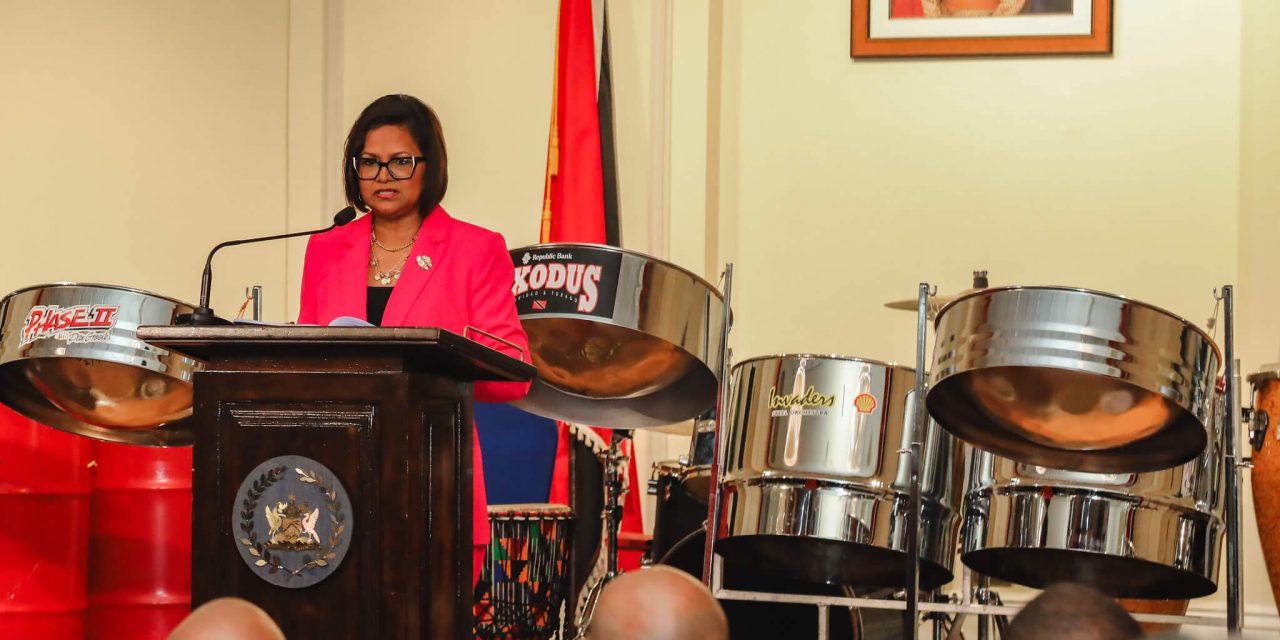
Good morning.
A steelpan does not find its voice by accident.
A master tuner approaches the instrument with vision, skill and an attentive ear. Each note must possess clarity of its own, but no note exists for itself alone. The tuner brings distinct voices into right relationship, until metal becomes music.
A nation also finds its voice in this way. We do not create harmony by erasing difference. We create it when each person receives the care, instruction, discipline and opportunity needed to contribute to a common purpose.
It gives me great pleasure to welcome you to the opening of the third President’s Pan Camp – a space where, once again, our nation’s young people will receive the care, instruction, discipline and opportunity to which they are entitled, and with which we are obligated to provide them.
This year, the Camp extends across six days, one more than in each of its first two years. Twenty-six young people will learn not only how to play our national instrument, but also how to listen, cooperate, persevere, create and take responsibility for one another.
This Camp holds particular significance. In 2026, we commemorate the 150th anniversary of The President’s House and the 50th anniversary of the Presidency and of our Republic. For the first time, the Camp will take place not merely on these grounds, but within The President’s House itself.
This building once stood at the centre of colonial authority. This week, its halls will carry the sound of young citizens who claim their culture, discover their abilities and help to shape the Republic’s future. A national house fulfils its highest purpose when it opens its doors to the nation’s possibilities.
When I assumed office in 2023, I pledged to make the Office of the President more accessible, especially to our young people, and to advocate for the widespread adoption of youth programmes based on the panyard model throughout our communities. This Camp gives practical form to that pledge.
Our theme, “Three Years. One Rhythm. A Future in Motion,” reflects the progress of this initiative. We welcomed twenty-one Pan Campers in 2024 and twenty-five in 2025. Many continued with pan through junior, school, and community bands or through private tuition. This year, another twenty-six young people join that continuing story.
I thank every tutor, mentor, volunteer, parent, guardian, partner, and member of staff who has made this year’s Camp possible. Your work proves that the most valuable investments do not merely raise buildings. They raise confidence, competence, character and hope.
As we open this year’s Camp, however, I wish to speak plainly about a matter of national importance.
Our wider society still does not fully understand the power of the panyard and the panyard model.
We often say that the panyard is “a place of discipline”. That is true—but it is a serious understatement. To describe the panyard only in those terms is to hear one note and mistake it for the whole arrangement.
The panyard is not merely a rehearsal space. At its fullest, it serves at once as an educational plant, an industrial zone, a micro-economy, and a civic anchor.
As an educational plant, it joins music literacy to reading, history, science, inquiry and peer-led learning. Young people learn from teachers, from elders and from one another.
As an industrial zone, it opens pathways into metallurgy, acoustics, engineering, welding, tuning, design and advanced instrument manufacture. It leads our Pan Campers into an encounter with the technical knowledge and indigenous innovation that sustain the pan industry.
As a micro-economy, it supports work in areas such as textile and costume design, recording, performance, tourism, food and hospitality. It can turn native intuition and resources that lie dormant into skill, enterprise and livelihood.
And as a civic anchor, it teaches organisation, accountability, conflict resolution, restraint and service. It gives a young person a place where someone knows his or her name, notices an absence, corrects an error and expects a return.
The President’s Pan Camp brings those functions together here at The President’s House. Music instruction forms one part of the experience. Mentorship, technical exposure, civic education and insight into the wider pan economy form the rest. The Camp does not imitate only the sound of the panyard. It seeks to reproduce its social architecture.
That architecture resembles a home. Its relationships resemble a family.
In a true panyard, elders in their seventies and eighties may stand beside people four generations younger. Different ages, occupations, neighbourhoods and social backgrounds meet under one roof for a beneficial purpose. Many players receive little financial reward, yet they return night after night. Their discipline does not arise from payment. It arises from belonging, responsibility and pride in the collective result.
Two examples reveal what this means.
During practice for Panorama one year, multiple murders occurred in the wider Tunapuna area, while Exodus was rehearsing in its panyard. Yet the players remained at practice because that panyard had earned a reputation as a safe place.
We should reflect on that. Violence had disturbed the surrounding community, but the panyard preserved a zone of order, trust and shared purpose. A society must count not only the crimes that occur around a community, but also the institutions that keep people steady and safe within it.
At Skiffle—long known as Skiffle Bunch—in 2026, two female medical students from The University of the West Indies practised beside their taxi driver, who was also a member of the band. Inside the panyard, their qualifications and occupations did not determine their worth. Each player accepted the same discipline and the same duty to the music.
When practice ended late at night, sometimes in the early hours of the following morning, the driver waited and took the students safely back to the University. The care of the panyard did not end with the final note. It travelled with them.
That is why the panyard is a great equaliser. It does more than place people of different social backgrounds beside one another. It teaches them to recognise mutual obligation. It converts proximity into fellowship and fellowship into care.
These are not sentimental side stories. They are evidence of social infrastructure at work.
A little more than three years have passed since I assumed office as President. During that period, I have had occasion, under our Constitution, to proclaim three states of public emergency, each against a background of grave threats linked to violent crime.
That fact should give us all pause.
Emergency measures may create necessary space for the State to confront immediate danger. But they cannot, by themselves, give a child a mentor, turn talent into skill, restore trust between neighbours, build a livelihood or teach people how to resolve conflict without violence.
Protection matters. But prevention matters too.
Crime feeds not only on the moment when a law is broken. It also feeds on what fails to happen before that moment: a child whom no responsible adult knows; a gift that no one develops; an adult whom no young person trusts; a community without a safe place; a future that no one helps a young person to imagine.
The panyard model can answer many of those absences.
It does not replace effective policing, a fair justice system, strong families, good schools, faith communities, social services, or decent work. But it strengthens the social ground on which all of those institutions must stand.
The panyard model is therefore not just about music. It is about teaching one another how to exist as a society.
That lesson has special force in Trinidad and Tobago. We inherit many faiths, cultures, ancestries and social experiences. We worship in different ways, observe different traditions and hold different views. Our unity cannot depend on sameness. It must depend on habits that allow difference to serve a common good: listening, timing, restraint, respect, responsibility and trust.
Every steelband makes that principle audible. Each instrument retains its character. Each section performs its part. No section claims the whole song.
Large and thoughtful voices have made this case for decades. Lloyd Best urged us to see the panyard and “schools in pan” as sites of education, enterprise, indigenous innovation and community renewal. Other commentators have persistently pressed the case for the panyard model and for the social and economic dividend it can yield. Steelband elders and community workers lived the model long before policy gave it a name.
Today, I add my voice to theirs. The hour for admiration without action has passed. We cannot celebrate the steelpan as our national instrument while we underinvest in the institution that has sustained it. We cannot praise Panorama and then leave panyards without the resources to serve communities throughout the year. Seasonal attention is not a national strategy.
I therefore call on the Government and the wider public sector, the private sector, educational institutions, faith communities, civil society, and the steelband movement itself, to form a serious national compact around the panyard model.
The public sector should recognise viable panyards as essential, year-round community infrastructure. The private sector should move beyond short-term or seasonal sponsorship and make sustained investments in youth formation, technical training and enterprise.
The time is long overdue for both sectors to commit substantial resources to safe facilities, trained mentors, reliable transport, instruments, child-protection systems, apprenticeships, technology and pathways into employment and business. The time is long overdue for us to connect panyards more closely with schools, universities, vocational institutions, MITTCO, the creative and tourism sectors, social services and community-safety programmes. The time is long overdue for us to measure results, refine what works and extend the model across communities throughout Trinidad and Tobago.
It is time for goodwill to become structure. It is time for admiration to become investment. It is time for urgent action.
To our Pan Campers: for the next six days, this House is your panyard. You are safe here. Recent events have reminded us that the relationship between the steelband movement and public authority has not always been an easy one. Questions connected with any particular incident must, of course, be resolved through the proper processes. Yet the larger principle is clear: order and culture need not stand opposed. And here, at President’s House, your music will affirm the honoured place that the steelpan – and all who give it voice – hold in our national story.
Learn the notes, but also study the relationships that make the music possible. Ask questions. Accept correction. Encourage one another. Notice who needs help. Take your place without denying space to anyone else.
You are not merely future citizens. You are citizens now. The habits you form here can influence your schools, your homes, your communities and, in time, our country.
At the beginning of these remarks, I spoke about the pan tuner. The tuner does not force every note to sound the same. The tuner gives each note its clearest voice, then brings every voice into harmony.
That is also our national task: Not to erase difference, but to prevent difference from becoming division. Not to wait for crisis, but to build communities of duty and care. Not merely to praise potential, but to invest in it.
Let the rhythm of this Camp travel beyond these halls—into policy, business, education, family life and community action. Let every viable panyard become a place where a child is known, a skill is learned, a neighbour is protected and a future takes shape.
Three years have brought this Camp to this moment. One rhythm calls us to shared purpose. The future will move only if we do.
May the hopes we share, the prayers we offer in our different traditions and the work we undertake together strengthen this Camp and our Republic.
It is now my great pleasure to declare the third President’s Pan Camp officially open.
Thank you.
See full album below: