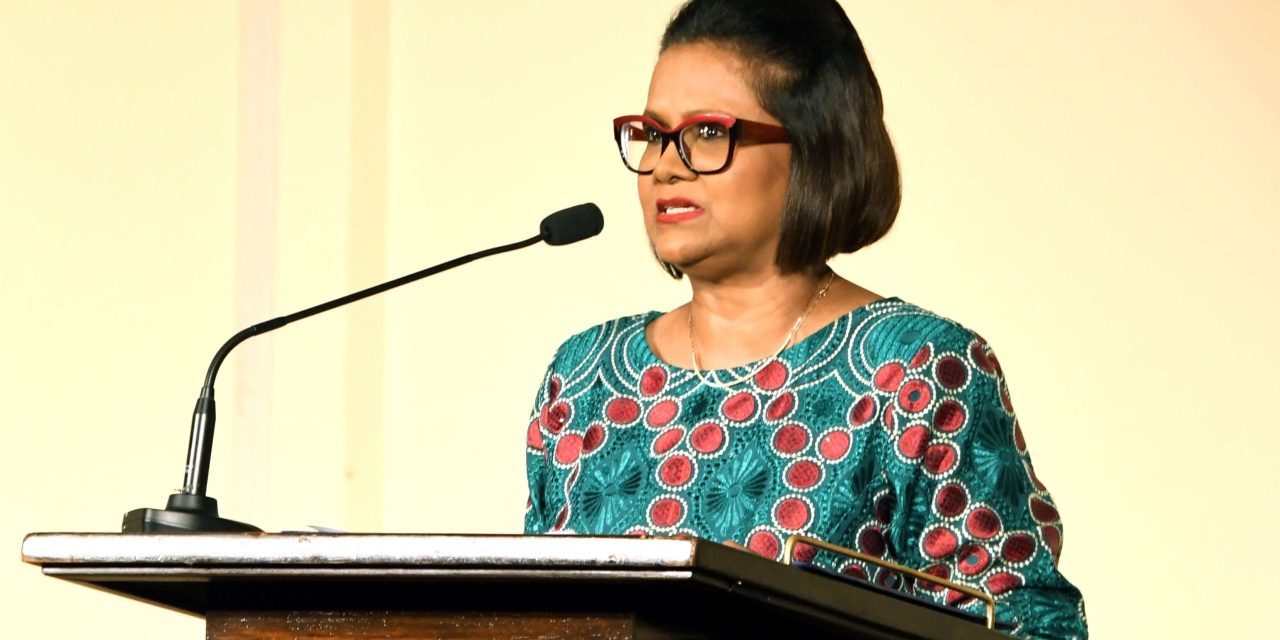
Good morning.
A few moments ago, we witnessed more than a play. We witnessed memory take human form.
Freedom Morning Come invites us into an imagined conversation among enslaved Africans as they await the reading of the Emancipation Proclamation in 1834. It reminds us that history does not live only in books, archives and monuments. History also lives in voice, rhythm, silence, gesture, pain, courage, and hope.
That is why this performance carries such force. It does not ask our students merely to know that Emancipation happened. It asks them to consider what freedom meant to those who had to demand it, wait for it, struggle toward it, and then protect it from delay.
It is deeply meaningful that, for the first time, Freedom Morning Come has come to The President’s House. This House stands on land once associated with Paradise Estate. The name “Paradise” sits uneasily beside the memory of those whose labour, suffering and denied humanity formed part of that history. Today, on these grounds, students have heard the voices of the enslaved not as shadows from the past, but as teachers for the present.
This year gives the occasion even deeper significance. In 2026, Trinidad and Tobago marks 50 years of the Office of President, created when our country became a Republic in 1976. We also mark 150 years since this President’s House in Trinidad was completed in 1876. A building first raised in the age of colonial authority now opens its doors to young citizens of a Republic, so that they may reflect on freedom, dignity and the responsibilities of national life. That reversal is not decorative. It is the work of history.
I thank the Idakeda Group, the cast, the creative team, and all who have preserved and presented this important work over the years. Through your artistry, you have served education, culture and country. You have reminded us that Caribbean theatre does not merely entertain; it can instruct, provoke thought, preserve memory and enlarge conscience.
I also thank, in a special way, the Principals who accepted the invitation from the Office of the President and made it possible for their students to be here today. Believe it or not, some Principals actually declined the invitation. But, by your acceptance, you honoured not only protocol, but possibility. A Presidential invitation extended to students is not a routine courtesy. It is an invitation from the Republic to its next custodians.
To every school Principal who may receive such an invitation in future, I respectfully say this: when the Republic opens a door for its children, adults should make every reasonable effort to let them pass through it. Some opportunities do not repeat themselves. A young person’s encounter with history, culture and civic meaning inside this House deserves to be treated as more than a matter of convenience.
To the students, I say: you were not invited here simply to watch a performance. You were invited to enter a conversation about who we are, where we have come from, and what kind of nation you must help us become.
Trinidad and Tobago is a Republic of many inheritances. African and Indian, Indigenous and European, Chinese and Middle Eastern, mixed and still evolving. Christian, Hindu, Muslim, Spiritual Baptist, Orisha, Baha’i, Buddhist, Jewish, and citizens of other faiths and of no religious faith. Our diversity is not a slogan. It is a daily discipline. It requires us to know one another by name, not by label. It requires us to resist the easy comfort of suspicion and choose the harder work of fairness.
That lesson matters in every age. It matters especially in moments when public life feels strained; when citizens feel anxious about the balance between safety and liberty; when questions arise about lawful authority, public trust, and the dignity of the individual.
The Office that I hold stands apart from partisan contest. It must not enter where the Constitution assigns responsibility to other institutions. But neutrality does not mean indifference to the values on which the Republic rests. And it certainly does not mean that a President must feign either an unawareness of, or an indifference to the anxieties that beset our citizens. Quite the opposite: the Office that I hold requires me both to acknowledge those anxieties openly, and to call for fidelity to the values on which our nation rests. This is among the many lessons that today’s play teaches. It teaches us that the freedoms upon which our nation is built, require to be defended by every one of us.
The duty of a Republic is to protect its people. A Republic must protect the rights that give citizenship its meaning. Freedom has many faces. It includes freedom from bondage. It includes freedom of conscience. It includes freedom of lawful expression. It includes freedom from arbitrary treatment. It includes the freedom to belong fully to the national community without the burden of inherited suspicion. These are the freedoms which today’s play calls upon all of us to protect.
The cry we heard in this play — “Pas de six ans, point de six ans”; not six years more — was not merely a demand about time. It was a demand about dignity. It rejected the idea that freedom could be promised in principle and postponed in practice. It reminds every generation that noble words do not suffice unless institutions, leaders and citizens give them life.
That is the universal lesson of Emancipation. Freedom is not a souvenir from 1834. Freedom is a duty. It must shape how we govern, how we enforce the law, how we speak about one another, how we disagree, how we teach our children, and how we treat the person whose voice, history or circumstance differs from our own.
Students, one day the responsibility for this Republic will rest more heavily on your shoulders than on ours. Learn your history. Learn it honestly. Do not inherit the pain of the past without also inheriting the courage of those who survived it. Do not inherit freedom as a trophy. Receive it as a trust.
The men and women whose imagined voices we heard today did not ask history to pity them. They asked history to hear them. If we have truly heard them, then we must leave this place with renewed respect for human dignity, renewed vigilance in defence of freedom, and renewed commitment to one another as citizens of one Republic.
So, let this first performance of Freedom Morning Come at The President’s House in this anniversary year mean more than a cultural occasion. Let it mean that this House can hold memory without fear, power without arrogance, protocol without distance, and young people at the centre of the national story.
May this Presidency, at 50, and this House, at 150, remind us always that the Republic does not belong to power. Power belongs in service to the Republic; and the Republic belongs to all its people.
May each of you leave today resolved to keep freedom not as a word we praise, but as a duty we perform.
Thank you.
See full photo album below: