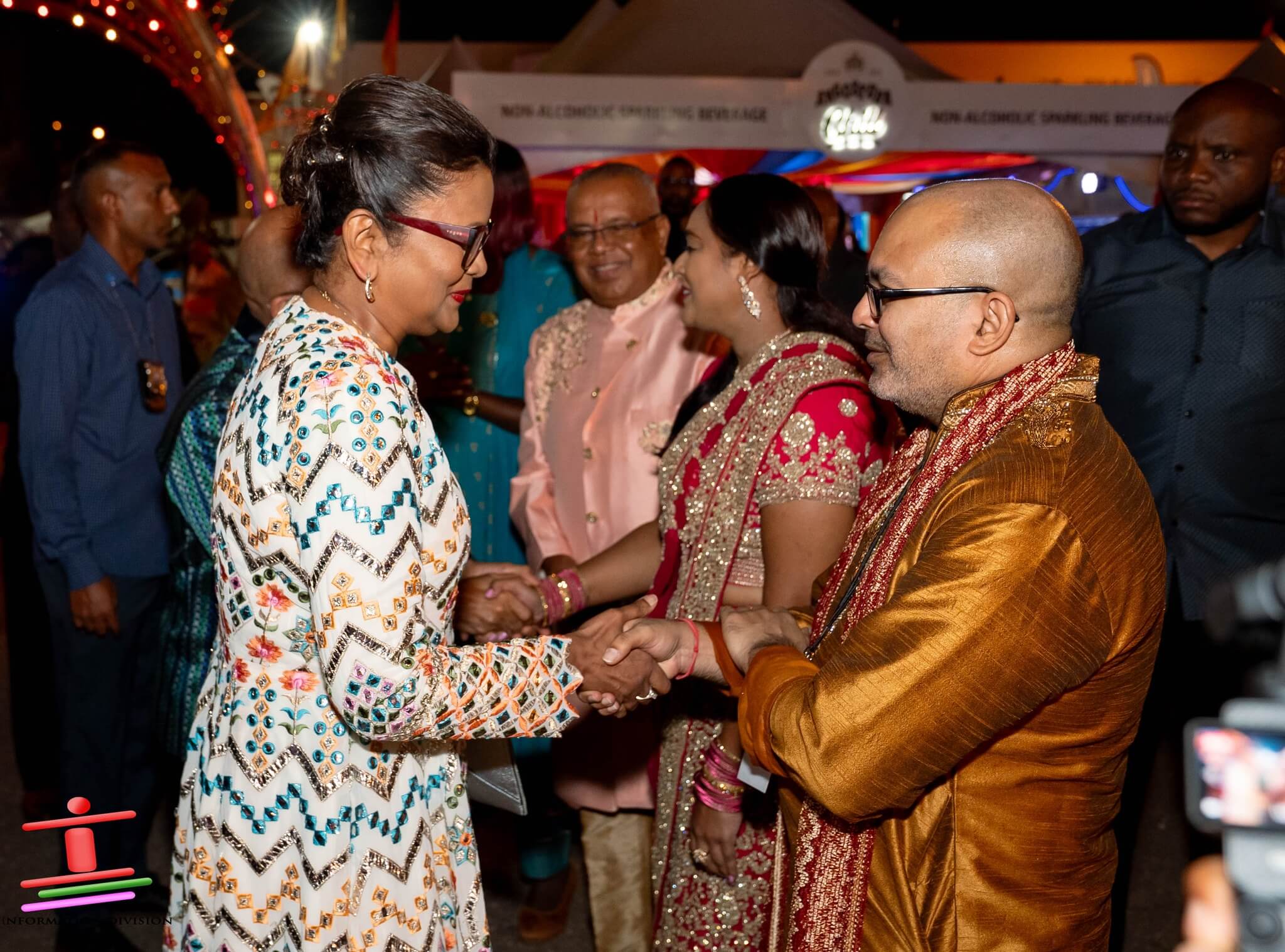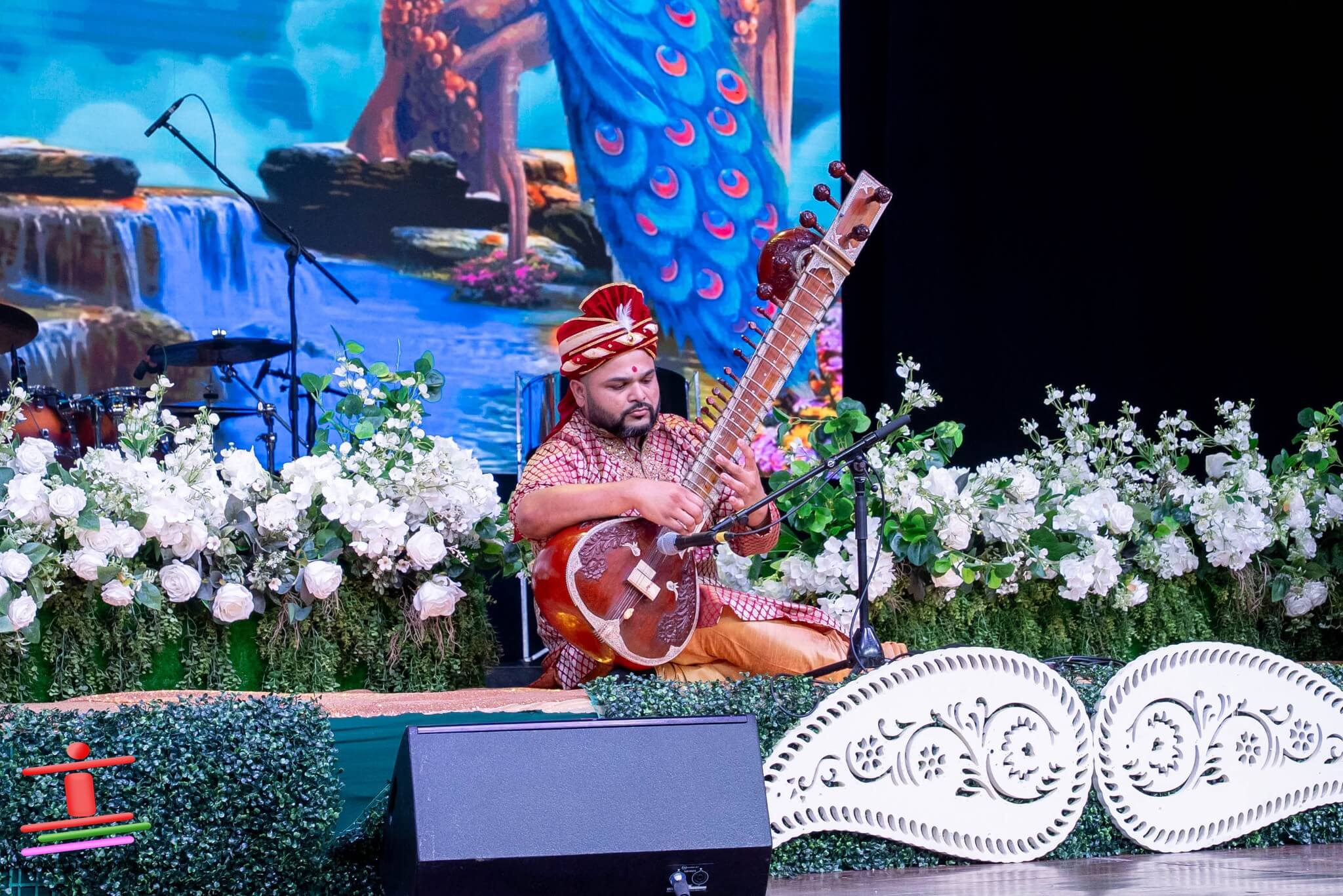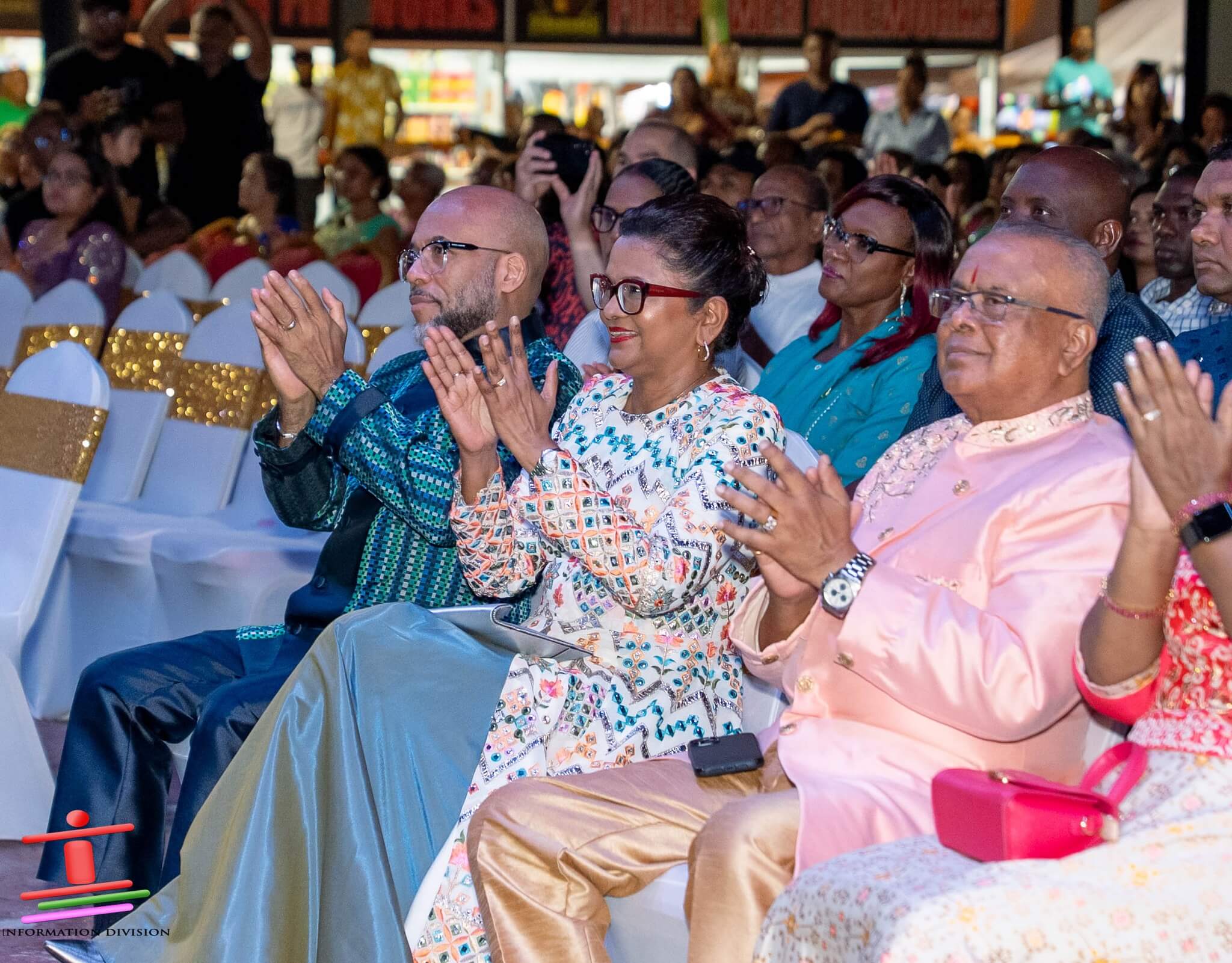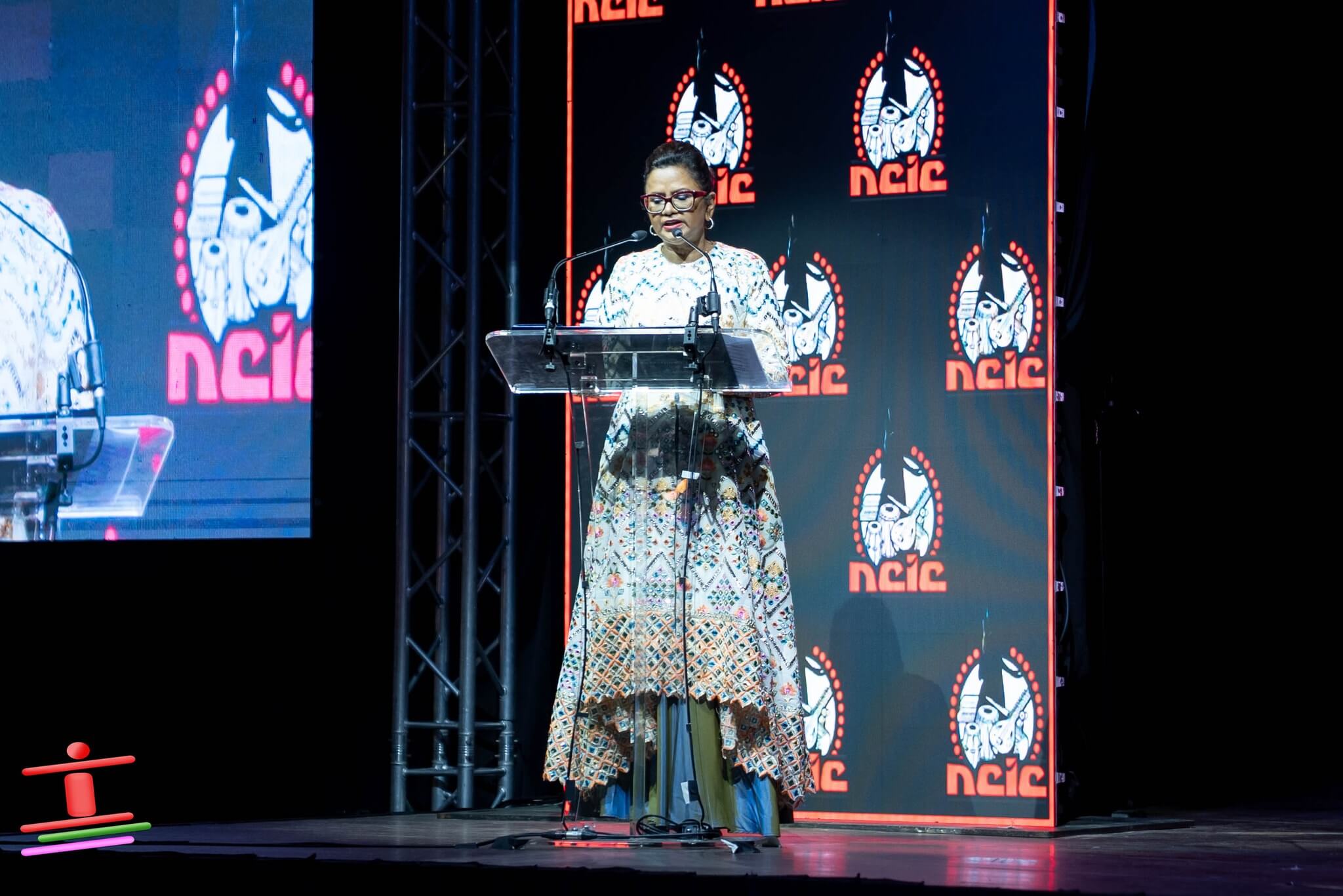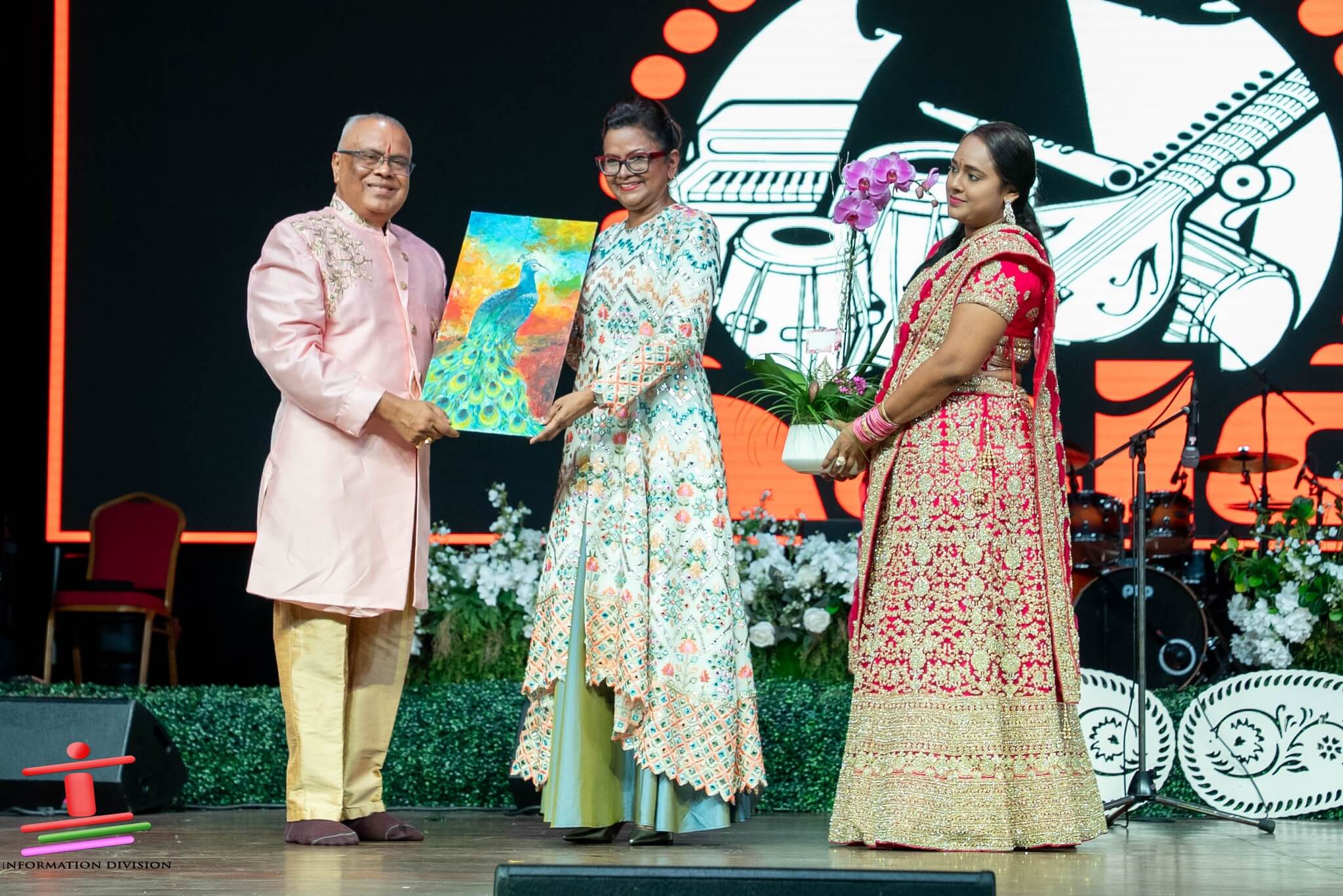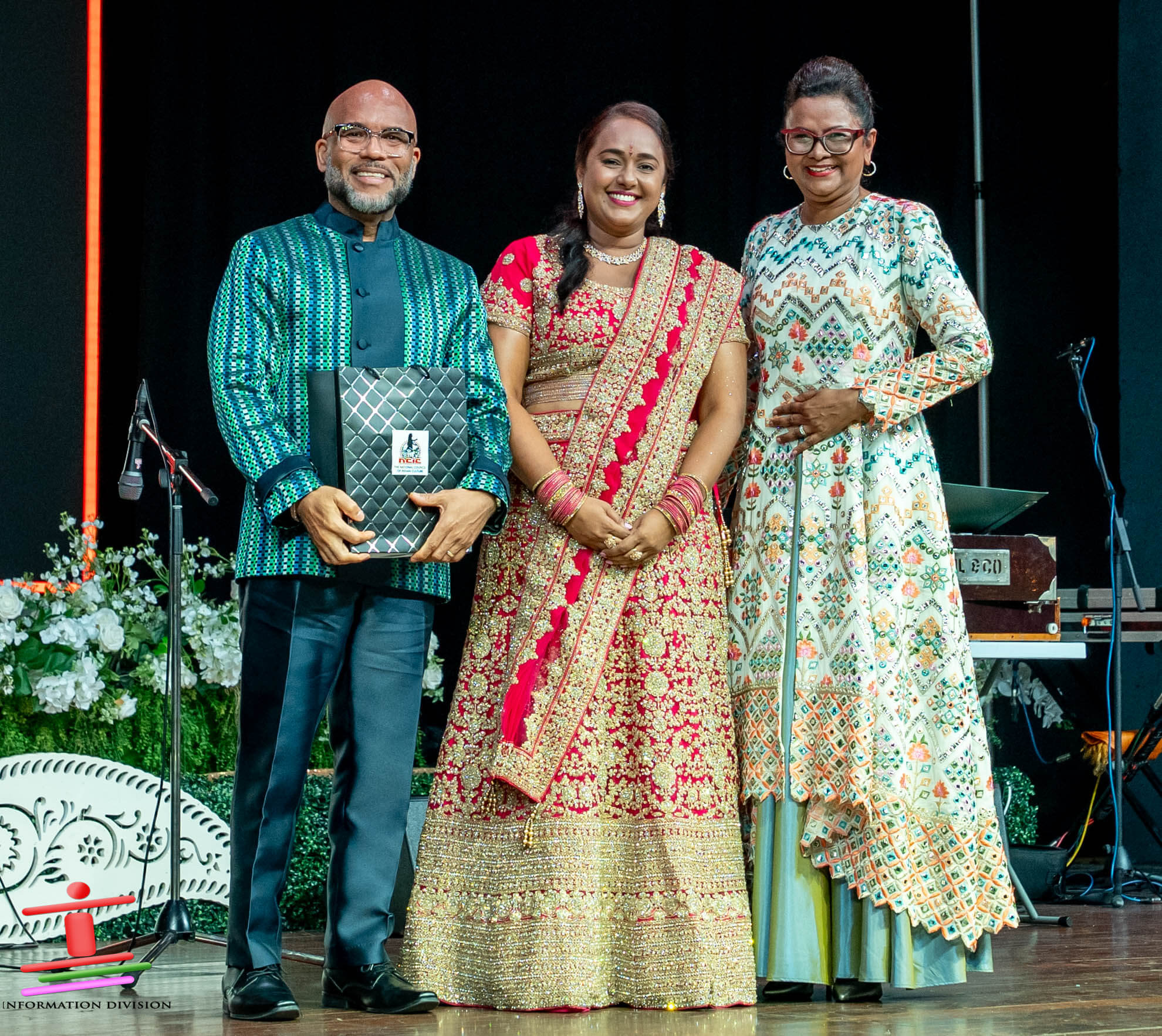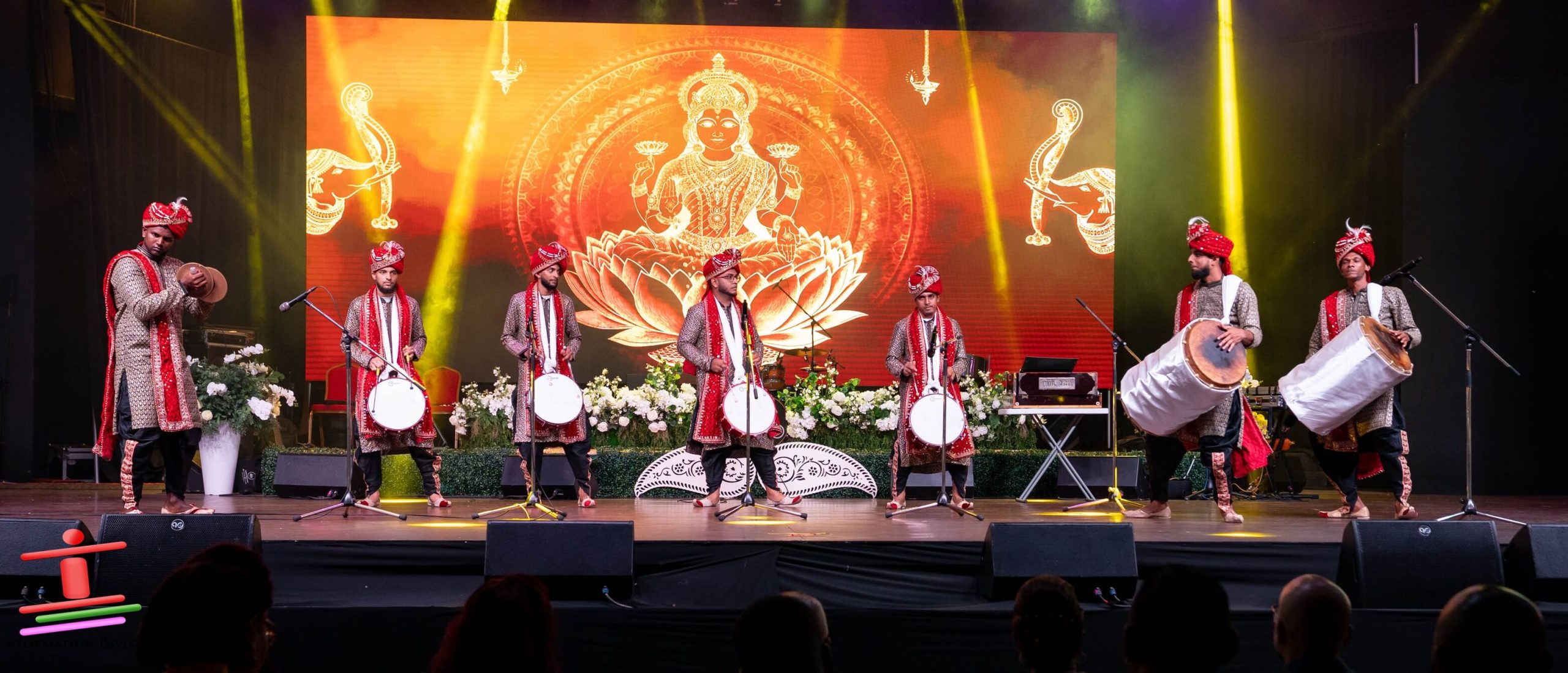
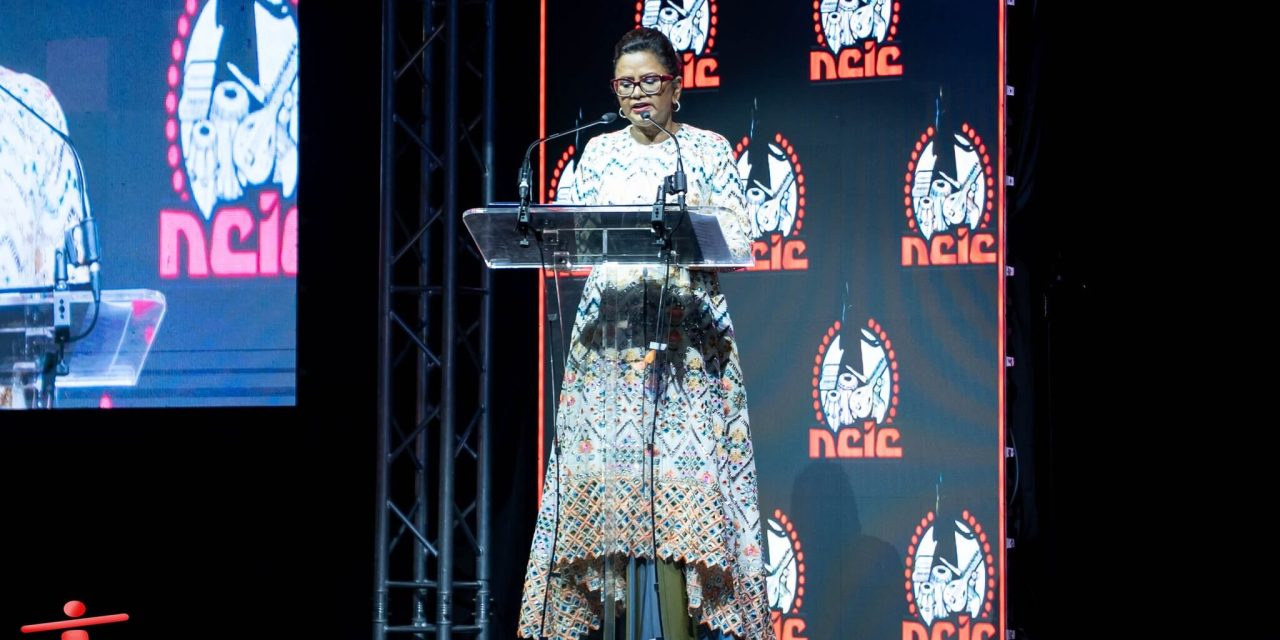
On Wednesday October 15, 2025, for the third consecutive year, Their Excellencies Christine Carla Kangaloo, O.R.T.T., President of the Republic of Trinidad and Tobago and Kerwyn Garcia, S.C., First Gentleman, attended the annual Divali Nagar.
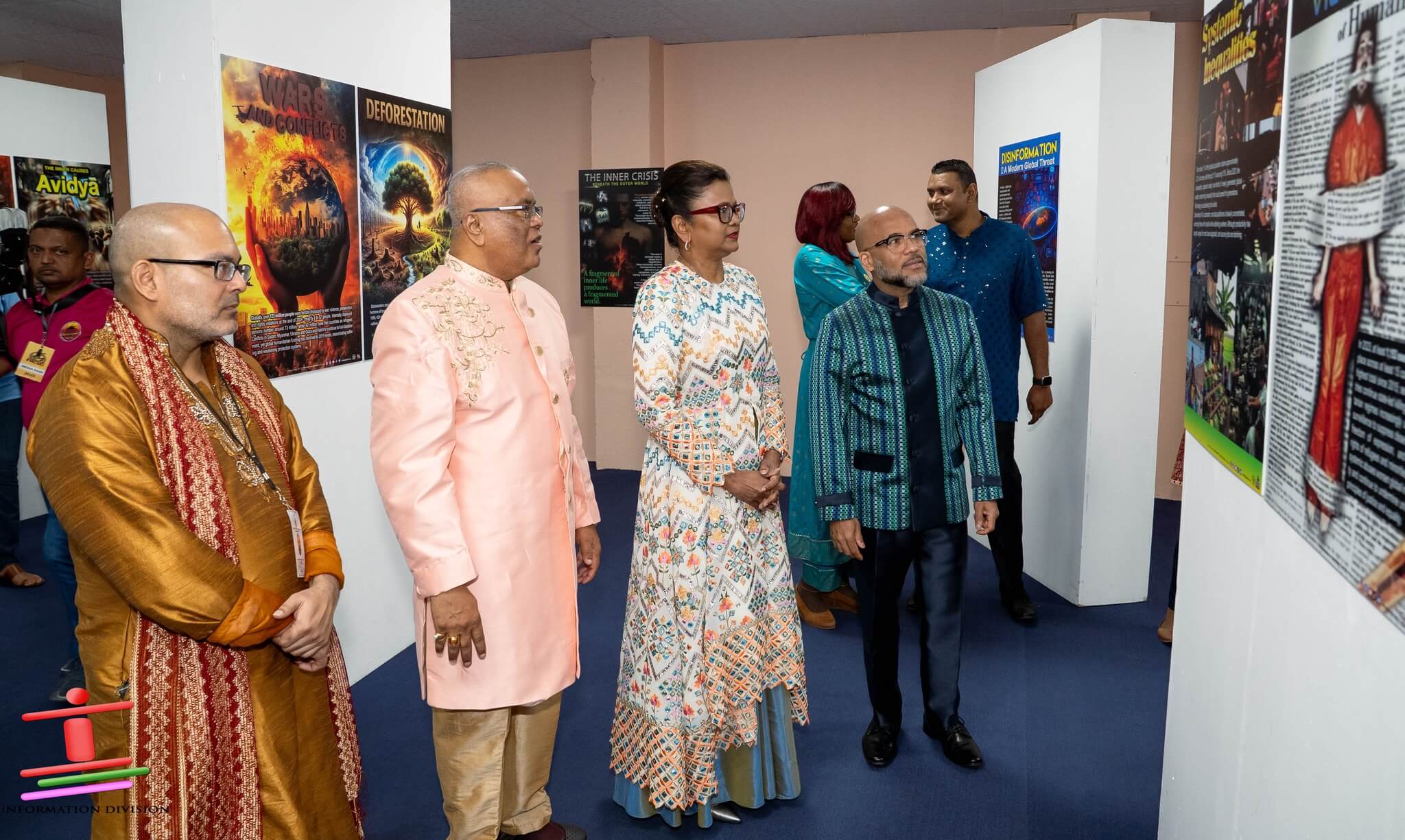
Prior to the start of the night’s official proceedings, Their Excellencies were warmly welcomed by National Council of Indian Culture (NCIC) President, Mr. Surujdeo Mangaroo, and invited to view the Thematic Exhibition housed at the NCIC titled “Loka Sangraha — The Welfare of the World.”
See full text of speech below:
Sita Ram and Good evening.
It is always such a joy and such a pleasure to return to the Divali Nagar. Every visit feels as special as the first. My husband and I always look forward to experiencing this vibrant display of religion, history, culture and the arts which continues to occupy a special place in the hearts of Trinbagonians, nearly four decades after its inception. What a treasure it is to have this annual celebration to which to look forward. What a privilege it is to call it our own.
At this very site last year, we remembered, with gratitude and with reverence, the immense contribution to Divali Nagar made by the late Dr Deokinanan Sharma, who passed from this life in August of 2024. This year, at this site, we remember with equal gratitude and reverence, the contribution made by the late Senator Deoroop Teemal, the former President of the National Council of Indian Culture (NCIC), who passed from this life in August of this year. Like Dr. Sharma, Senator Teemal’s contribution to Divali Nagar was immense. Like Dr. Sharma, Senator Teemal will be sorely missed. On behalf of a grateful nation, I say thank you to Senator Teemal and to his family, for having given such selfless service to Trinidad and Tobago, and to humanity as a whole. As one of your speakers put it so eloquently when he addressed you last Saturday evening, Senator Teemal’s legacy will live on in every deya lit, and in every act of seva performed in the name of culture and faith.
In the same spirit of gratitude, I also wish to thank the NCIC for its kind invitation to address you this evening and for its continued commitment to preserving and promoting such an indelible part of our national heritage. Since its founding in 1986, the Nagar has been a pillar of that noble endeavour, growing in scope and influence well beyond what its founders would have originally imagined. I congratulate Mr. Mangaroo on his appointment as President of the NCIC, and wish him all success as he embarks on his stewardship of the NCIC to continue its important and invaluable work.
I would also very much like to commend the NCIC for its insightful choice of this year’s theme for the Nagar, “Loka Sangraha,” which translates to “the welfare of the world.” It is a theme that is both thought-provoking and timely. More than that, I believe it is a theme that can illuminate a path forward for our country. I believe that if each of us were to understand, embrace and live by the principles of Loka Sangraha, we would be better able to contribute to a more harmonious and resilient Trinidad and Tobago, and to surmount the various challenges which face us today.
In the Bhagavad Gita, Lord Krishna teaches Arjuna that one’s duty should be performed not merely for personal gain, but rather, for the greater good. I understand Lord Krishna’s message to Arjuna to be that in all our actions we must consider the society and the world; and that although we can and should strive to achieve personal goals, we must keep in mind the larger social and world goals of preserving dharma and order, and of achieving harmony, unity and universal welfare. I understand Lord Krishna to have been emphasizing that when we fulfil our responsibilities selflessly, we help uphold the order and well-being of society.
Loka Sangraha therefore calls us always to act with a view to contributing to the greater good.
I believe that this theme could not be more fitting for the world in which we live today. All across the globe, we are witnessing rising conflicts, deepening inequality, increased environmental degradation, and the steady erosion of fundamental values of civility and compassion. Trinidad and Tobago, though blessed in many ways, is not immune to these pressures. We face economic challenges, rising crime and the daily struggle to preserve our moral and spiritual values. Sadly, we live in a society in which many of us seem content to abandon the basic values and principles that we were taught as children, in favour of a few, fleeting moments of fame, or of fortunes that bring us neither real nor lasting peace.
Against this backdrop, Loka Sangraha speaks powerfully to us. It urges us to understand that, while we are certainly entitled to pursue our personal goals, we nevertheless have an overriding duty to act in ways that sustain our wider communities, and the whole of humanity. It urges us to recognize that we are not in this life only for ourselves; but that we are in this life to serve one another, and that, in so doing, we serve the greater good.
Although Arjuna was a prince and a warrior of royal lineage, Loka Sangraha applies to us all. Loka Sangraha is not just for rulers. It is for everyone. Why?
Because the world is not shaped only in parliaments or palaces.
It is shaped in homes, in classrooms, in workplaces, in everyday choices, and in ordinary acts of kindness. Leaders may make laws, but it is people who make society.
Leaders may set direction—but it is we who create the culture.
Not too long ago, I read of a story which brought this message powerfully home to me. If I remember correctly, it went something like this:
A man was riding on a bus home from work one evening when he received a call from his sister, telling him that their mother had died. It was difficult for him to hear her clearly because the phone signal kept dropping in and out. So, he repeated back out loud what he thought he heard her say for confirmation, and when she confirmed it, he put his phone away and started staring blankly into space.
All he could do in that moment was remind himself that he only had a few more stops to go, before he could get off the bus and walk home. So, he tried to keep his emotions in check until then. But, he couldn’t. His face swelled with grief and sadness. He became lost in his grief and was lucky to remember to get off the bus once his stop had arrived.
He came off the bus and started the short walk to his house, unaware that a stranger was following him. From what I remember from the story, the conversation went something like this, as the stranger sped up his pace to reach the grieving man:
“Excuse me, brother. You don’t know me, but I overheard your conversation on the bus”, he said.
“What??” the grieving man asked, confused by the surprised disruption.
“Well, you don’t know me, but I heard you on the bus, and maybe I’m wrong, but it seems like you lost your mother just now, and I see the pain you are in” the stranger responded.
“Ok…so?” the grieving man said, with a duality of anger and indifference.
“Well, this is not even my stop man. In fact, I live about another 10 stops away, but felt the need to tell you something, which is why I got off the bus and took this chance. I recently went through the same thing, losing my mother. I just felt the need to tell you that it’s going to be ok eventually. It’s painful and you’re hurting, but you will be ok, and I’m sorry for your loss.”
With a feeling of surprise and disbelief, the grieving man paused for a few seconds, then said to this kind stranger, in a trembling voice with words of gratitude:
“Thank you, man, I appreciate it.”
With that, the stranger left, walked back to the bus stop and jumped on another bus and continued his journey. That selfless act by that stranger restored, if only for a minute, the grieving man’s belief that the world could be a good place.
When I read that story, I thought it was a beautiful but, an unfortunately rare example of unselfishness in today’s world. I thought that it was a powerful example of Loka Sangraha at work – of how, in our everyday lives, we can make such a huge difference to others, by simple selfless acts of service to one another, and in doing so, uphold the order and well-being of society.
Closer to home, I recall how the selfless practice of the ethos of Loka Sangraha, by perfect strangers, made such a difference in my Mother’s life. In 1996, my Mother and my Father had travelled to the Bahamas for a vacation. Without warning, my Father collapsed while they were there, and my Mother found herself in a cold hospital room, all alone in a foreign country, without any support from a single family member, looking on helplessly at my Father and the machines that were barely keeping him alive. Into that dark and desperate experience, two (2) beautiful strangers entered. My Mother later learned that the Manager of the hotel at which she and my Father had been staying, had reached out to those two (2) women, who were also of Trinbagonian heritage, and told them of my Mother’s situation. Without hesitation, they came to the hospital and sat with my Mother, lending her the support that she so desperately needed, while she waited on the children to make arrangements to join her there. One of those women was at my Mother’s side when my Father eventually passed. It so happens that yesterday was the anniversary of my Father’s death. Mummy tells me to this day what a huge difference the presence of those two (2) women made to her during one of the darkest periods of her life. She still calls them her “angels”. Two (2) persons whom she had never met before, at the behest of a Manager who was kind enough to care, all of whom chose to act in a way that sustained my Mother, a stranger to them – and in so doing, reminded my Mother of the goodness in humanity.
The point I am trying to make is that Loka Sangraha can be seen at work in the everyday lives of ordinary people. Loka Sangraha is as much about the solemn duty of our leaders always to act in service of the welfare of the people, as it is about the simple acts of sacrificial kindness that we choose to show to one another as individuals. It is easy to show kindness to our loved ones; it is ‘Loka Sangraha’ when we show kindness to strangers. And I have come to believe that it is upon the kindness that we show to strangers – to those who even consider themselves our enemies – that the welfare of the world is truly built.
In Trinidad and Tobago, we are blessed to be able to witness so many examples of Loka Sangraha at work in our everyday lives, especially in the lives of our cultural pioneers, like Dr. Sharma and Senator Teemal, who dedicate themselves to preserving and passing down not only cultural treasures such as music, art, dance and cuisine, but also, cultural values which lift the soul of our society. Dr. Sharma and Senator Teemal did this, not for recognition or reward, but out of a deep love for their heritage and a profound sense of responsibility to the generations to come.
I believe that Loka Sangraha can also be seen in the service of our nation’s teachers who, with limited resources, oftentimes using their own funds, commit themselves to nurturing young minds and shaping futures. They see each student not just as a pupil, but as a potential light in the world. In our visits to schools throughout the country, my husband and I have been privileged to see the kindness that teachers show to their students, and at how they often take great care to assist their students without making them feel ashamed or embarrassed. Loka Sangraha can also be seen in the lives of the community volunteers who give their time and energy selflessly, reaching out to the vulnerable, uplifting the marginalised and protecting our environment. They are the inspirational citizens who embody Loka Sangraha and who understand the fact that nation-building rests in the hands of each one of us.
I have said that Trinidad and Tobago, like many other countries in the world, faces numerous challenges. But Trinidad and Tobago also has the benefit of being able to learn from and to practice principles such as Loka Sangraha, and from stories such as those told through the Ramleela. These timeless lessons remind us how to live with integrity, compassion and a sense of duty to one another. They teach us how to put these values into practice so that we can become better people, and by extension a better country, because of them.
If we can recommit ourselves to these values, if we can remember that the welfare of the nation begins with individual action, for example, showing kindness in the home, fairness in the workplace, integrity in all our dealings and selfless contributions in the public sphere, then, as a nation, we will together move ever closer to realising the ideal of Loka Sangraha.
Let us therefore take inspiration from this theme, and from the Season of Divali itself. Divali is, above all, a celebration of light – of light that dispels darkness and that signifies knowledge, wisdom and love. When we act selflessly for the welfare of others, we become bearers of that light, ourselves participating in the eternal victory of knowledge over ignorance, good over evil, and light over darkness. When we act responsibly, treat others fairly and serve selflessly, we help build a society that reflects the very light we celebrate at Divali.
I thank the NCIC once again for this extraordinary gift that is the Divali Nagar, and for its steadfast example of service to our nation. May this year’s celebration ignite in each of us a desire to embody the teaching of Loka Sangraha, and in so doing, become a stronger and more resilient society.
I wish you and the entire nation a happy and holy Divali.
Shubh Divali, and may God bless our nation.
I thank you.