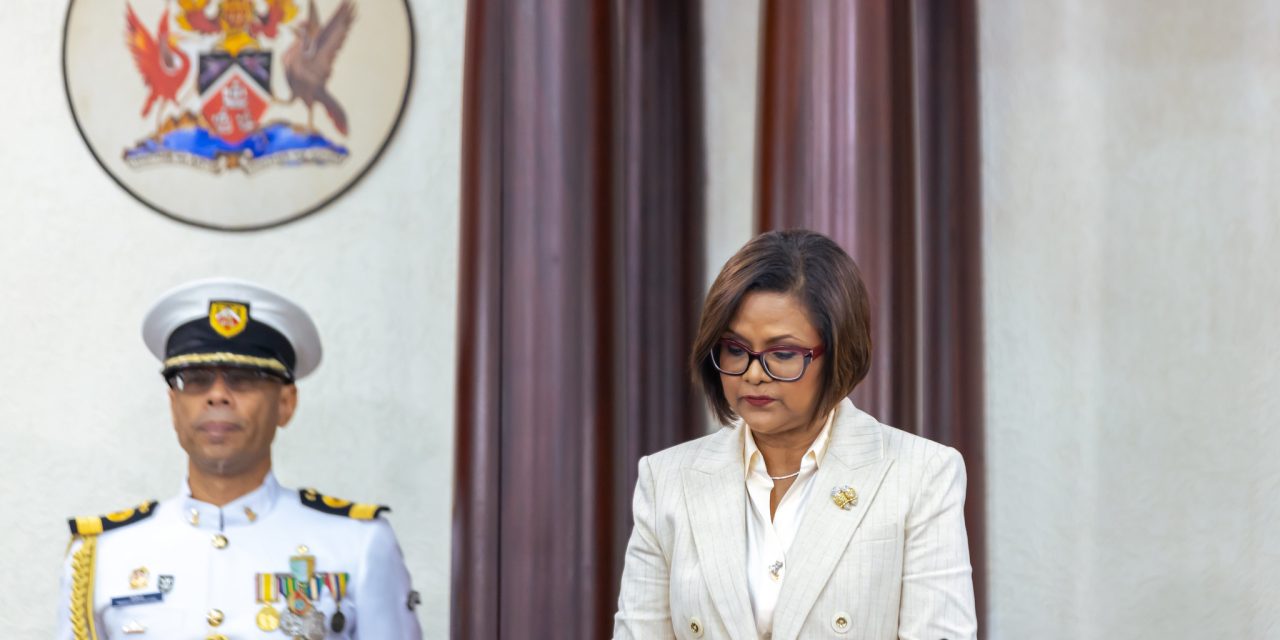
Permit me to begin by offering my sincere congratulations to the recently elected Members of the Assembly, and to you, Mr. Presiding Officer, for your election this morning to that esteemed position. By any analysis, the electoral victory that has ushered, into the Assembly, its Members for the next four (4) years, was as resounding as it was unambiguous. No amount of sophistry can diminish its magnitude. It was an unqualified and emphatic registration of the democratic will of the people of Tobago, to whom I also offer my congratulations for having participated in the electoral process. It came as some relief that the EBC’s official voter turnout figure was close to double that which initially made the rounds on social media on election night – although, of course, a higher voter turnout than 50.69% is to be desired.
But the desire of the people of Tobago is clear and the mandate that has been given to Members of this Assembly is historic. This is only the second occasion in the Assembly’s history on which a party has won every seat in the Assembly; and it is the first occasion that a party doing so has won as many as 15.
I wish also to express a nation’s gratitude to the men and women who offered themselves as candidates at last Monday’s elections. In very many respects, to offer oneself for public office, is, at its truest and best, an act of love. It is a decision to place the welfare of others above personal comfort; to accept responsibility for the hopes, needs, and future of a community; and to serve, not for recognition, but for purpose. When individuals step forward in this spirit, they affirm a profound truth: that love of country is not merely spoken, but lived. To all of the men and women who demonstrated, and who lived their love of Tobago, by offering themselves as candidates in this spirit, you have a nation’s thanks, and my personal admiration.
It was the American writer, Leonard Louis Levinson, who said: ““A pessimist sees only the dark side of the clouds, and mopes; a philosopher sees both sides, and shrugs; and an optimist doesn’t see the clouds at all, because he is too busy walking on them”. I think we can all agree that the victorious party at last Monday’s elections is entitled to walk on the clouds for at least a little while longer. They should, as I have said, let no sophistry diminish the sheer magnitude of the victory that they have accomplished. They should eschew the unrepentant pessimists among us who might seek to dim the light that shone so brightly for them at the polls. Still, there are, also among us, philosophers and analysts who see both sides of the proverbial coin, and who, while owning the jubilation of this historic moment – as they should – also see the challenges that so sweeping a victory can bring – as they also should. I cite, for example, Dr. Hamid Ghany’s poignant observations reported on in yesterday’s Guardian Newspaper, that while the mandate achieved by the victorious party strengthens their position numerically, it also presents an uphill task for effective governance. “It is a challenge” Dr. Ghany is reported to have said, “to govern without an opposition in the House, because sometimes you need the opposition to say things that you can respond to. When you’re listening to yourself in the House, it’s very different. You really depend on an opposition to raise issues that force a response”.
To Dr. Ghany’s voice, permit me to add my own. A mandate that results in no opposing voice in the Assembly, is a mandate that has to be exercised with great care, and with great maturity. We live in a time and a world of extraordinary change. Sadly, one of those changes is that the traditional guardrails upon which we once relied — those enduring principles and shared standards that guide and inspire higher standards of human conduct — are fast disappearing. I think it is a grave mistake to think of these guardrails as dispensable anachronisms. These guardrails are not mere formalities. They are the quiet voices that remind us, in the exercise of power, of restraint; in the pursuit of ambition, of humility; and in the exercise of freedom, of responsibility. When these guardrails disappear, we begin to speak and to act towards one another, as if nothing matters and as if no one is worthy of our respect – our language in the public space becomes more caustic and savage; our decisions and actions become more bullying and tyrannical; and we abandon, without so much as a blush, even deep-rooted constitutional conversations.
Ordinarily, with no opposing voice in a body like the Assembly, the risk of its Members succumbing to what at times feels like a global pact to annihilate these guardrails, would be high. But, like Levinson’s optimist, I walk today on clouds that tell me that, in the case of this Assembly, that risk is not high. One of the reasons why I believe the risk is not high, is that civil organizations in Tobago have stepped forward to give the assurance that, in the absence of an opposing voice in the Assembly, they intend to use theirs to help keep the Assembly accountable. My advice to Members is to listen to their voices. But most of all, the risk is not high because this is no ordinary Assembly. This is the Tobago House of Assembly; it is the Assembly of the people of Tobago – a people whom I knew growing up as renowned for their temperance and decorum; their moderation and self-discipline; their circumspection and propriety. The absence of an opposing voice in this Assembly is not necessarily a cause for alarm. Rather, it is a mandate which calls upon this Assembly’s Members, in the language of another famous American – this time, a former President – to lead, not by the example of your power, but by the power of your example.
It has been reported in today’s newspapers that the Council for Responsible Political Behaviour, the CRPB, identified several breaches during the election campaign of the Council’s Code of Ethical Policial Conduct. They included the use of inappropriate language, race-baiting, and defacement of political banners and paraphernalia. Now that the election is over, this Assembly has before it a wide-open political field upon which to write its story, and along with it, the story of the people of Tobago. Let it be a better story than that reported by the CRPB. Let it be a story that, in generations to come, we will all be proud to tell. Let it be a story in which, in a world scarred by fractiousness and abrasiveness, the people of Tobago were led by this Assemblyin the direction of their natural disposition – towards mutual respect and understanding, and away from animosity and intolerance. In some ways – perhaps too many and for too long, if we are honest – Tobago has stood in the shadow of its bigger sister, Trinidad. Let the story of this Assembly be the story of inspired leadership, by which Tobago took its bigger sister’s hand and led Trinidad away from the danger of devolving into a society fractured by mistrust, hostility, and division. Let it be a story in which this Assembly led the people of Tobago into a revitalized respect for and adherence to traditional guardrails, added to them those in the Tobago House of Assembly Act and the Constitution, including its conventions, and created, for the whole of Tobago, and displayed to all of Trinidad, a golden era of governance, guided by shared principles, restrained by virtue, and strengthened by trust.
Let your opposition be your conscience. Let your consciences lead you to discover what it truly means to have offered yourselves for public office. And, when the story of this Tobago House of Assembly is told by generations to come, may we all be able to sing, Trinidadians and Tobagonians alike, the immortal words of Tobago’s son, Michael Baker, “Come discover one of us; Come discover both of us; and why not come and discover all of us. For together we aspire and together we achieve. The way we live is hard for them to believe.”
May God bless you all. And may God bless our nation.